Information is the key differentiator in today’s economy. The right information at the right time could make the competitive difference.
What are the biggest problems facing enterprise information management today?
Where could the impact of mis-management of information systems be felt. Planning to write something on this issue based on my past expereince...
Jul 16, 2006
Enterprise Information Management problems

 User Experience Architect, Information Architect, Usability Professional,Doer, Abstract Expressionist,
Jul 10, 2006
Customer Behavior, Strategy & User Research
Today's customer has an amazing amount of choice of products and services at his/her fingertips. The wealth of information that they have is empowering them to call the shots.
Customer Behavior is becoming increasingly unpredictable today. Loyalty is at a premium. People are not hesitant to change brands at the slightest pretext/opportunity/benefit. There is a plethora of choices available. What is the differentiator? The Experience.
What does this mean for organizations/ Entrepreneurs?
It means that customer needs/ aspirations/have to be at the forefront of their business strategy. And the magic mantra for doing it is user research. Neglect it at your own peril.
Customer Behavior is becoming increasingly unpredictable today. Loyalty is at a premium. People are not hesitant to change brands at the slightest pretext/opportunity/benefit. There is a plethora of choices available. What is the differentiator? The Experience.
What does this mean for organizations/ Entrepreneurs?
It means that customer needs/ aspirations/have to be at the forefront of their business strategy. And the magic mantra for doing it is user research. Neglect it at your own peril.
User Experience Architect, Information Architect, Usability Professional,Doer, Abstract Expressionist,
Jun 12, 2006
Lack of Holistic Experience Design can impact Businesses.
While Shopping in a very popular supermarket in India, I realized how a bad design decision could cost the business its customers. Customer Experience encompasses the entire cohesive experience of the user/customer. From the interaction with the employees, the software, hardware, and the environment.
Scenario:
You (Customers) browse through items; collect items you want to buy; and finally line up to pay at the cashier’s counter. This counter is the major conduit for almost all customer interactions. So in my mind, this the most crucial action point the supermarket has with its customers.
Now one would expect that this conduit to facilitate the User (Cashier, employee) experience so that the customer need not wait unnecessarily, and would always be served with a smile. The cashier was standing and operating a system from a bygone era with an application from the same age. I am not discussing the software here. That would be another day another story.
Am talking about the completer experience. The cashier(User) is standing and operating a computer. Never a simple task. Especially when the user has to continuously operate the system for a long duration. Even the table height is fixed, so a tall person would face even more strain. The amount of strain that the user has on his/her back day in and day is going to affect his/her productivity. After entering the item details in the computer, the cashier has to bend again in a different direction to remove carry bags to give the customer. Another ergonomic disaster.
Productivity loss leads directly to lower morale among users which in turn leads to lower level of customer service. By not paying attention to the holistic experience, the impact directly falls on the customer whose experience is marred by the service, which takes a longer time due to these design (in) decisions.
What is stopping the customer to abandon the long queues here and go to another efficiently run place where he can get his services faster?
Scenario:
You (Customers) browse through items; collect items you want to buy; and finally line up to pay at the cashier’s counter. This counter is the major conduit for almost all customer interactions. So in my mind, this the most crucial action point the supermarket has with its customers.
Now one would expect that this conduit to facilitate the User (Cashier, employee) experience so that the customer need not wait unnecessarily, and would always be served with a smile. The cashier was standing and operating a system from a bygone era with an application from the same age. I am not discussing the software here. That would be another day another story.
Am talking about the completer experience. The cashier(User) is standing and operating a computer. Never a simple task. Especially when the user has to continuously operate the system for a long duration. Even the table height is fixed, so a tall person would face even more strain. The amount of strain that the user has on his/her back day in and day is going to affect his/her productivity. After entering the item details in the computer, the cashier has to bend again in a different direction to remove carry bags to give the customer. Another ergonomic disaster.
Productivity loss leads directly to lower morale among users which in turn leads to lower level of customer service. By not paying attention to the holistic experience, the impact directly falls on the customer whose experience is marred by the service, which takes a longer time due to these design (in) decisions.
What is stopping the customer to abandon the long queues here and go to another efficiently run place where he can get his services faster?
User Experience Architect, Information Architect, Usability Professional,Doer, Abstract Expressionist,
User-Centered Innovation Processes
Interesting post by Eric Von Hippel on User-centered innovation processes.
Should we involve users more in our development processes? Are business models going to change? Interesting article that gives us ample fodder for thought.
http://www.changethis.com/23.CitizenInnovator
Should we involve users more in our development processes? Are business models going to change? Interesting article that gives us ample fodder for thought.
http://www.changethis.com/23.CitizenInnovator
User Experience Architect, Information Architect, Usability Professional,Doer, Abstract Expressionist,
May 13, 2006
Language of business – for UX professionals.
In customer interactions, there is only one way to get your customers attention. The language of business. Many a times UX, or for that matter IT professionals have a condescending attitude towards customers and their business needs. After all, we are the “experts”. We know what’s right for their users. We have the best solutions, We are the tech gurus.
Right?
Wrong.
We are being called to provide solutions that will impact our customer’s businesses. They will draw a definite blank or will not be able to sustain interest in our ramblings if we harp on user research, contextual enquiries, card sorting etc. Not all clients are aware of usability methods and techniques, and they need not be. We have to articulate how these techniques will impact their business. Then they will listen. Even when presenting ideas, always make a point with a business case, never because some usability guru said so.
We have to get out the “consultant/ Expert” mode, and start forming partnerships with our clients. Treat their business as your own, and their success as your success. This is not an idealististic harp, but a pragmatic way of business in today’s world.So, are we prepared to talk the language of business
Right?
Wrong.
We are being called to provide solutions that will impact our customer’s businesses. They will draw a definite blank or will not be able to sustain interest in our ramblings if we harp on user research, contextual enquiries, card sorting etc. Not all clients are aware of usability methods and techniques, and they need not be. We have to articulate how these techniques will impact their business. Then they will listen. Even when presenting ideas, always make a point with a business case, never because some usability guru said so.
We have to get out the “consultant/ Expert” mode, and start forming partnerships with our clients. Treat their business as your own, and their success as your success. This is not an idealististic harp, but a pragmatic way of business in today’s world.So, are we prepared to talk the language of business
User Experience Architect, Information Architect, Usability Professional,Doer, Abstract Expressionist,
May 12, 2006
E-learning as a crutch for bad usability
Too much faith on eLearning or “help” for business applications is a dangerous trend in the software industry. How many times have we heard clients insisting on user manuals and training modules at the UAT stage, when their focus should be on actually testing the application with end users?
A typical scenario of customers and developers understanding on “ application usability” and user behavior.
Clients/ Developers
Usability professionals
…
It is a fallacy to believe that users will go laboriously through your painstakingly written help manuals or documentations. What they really want is to complete their tasks as fast as possible without depending too much on instructions. Of course in a utopian situation, the best “help” is no help at all, but in reality it does not work that way. By all means have help, and eLearning, but do not do so at the cost of neglecting users, their feedback, testing, etc. Banking on a help module or an eLearning module to help users is a sure shot way of your application being doomed before it is even launched.
There is no substitute for the UCD process in designing software. What you do later will at best akin to providing a crutch. Enough said. Kapiche?
A typical scenario of customers and developers understanding on “ application usability” and user behavior.
Clients/ Developers
“We definetly care about users, we have dedicated staff for writing
"help" and also have a downloadable PDF user manual. It has 500 pages of
detailed instructions on all the tasks and also the underlying architecture and
the technology that we are using. In fact in version 2, we are going to be even
better, we will launch an eLearning module for the same. We will force users
to go through the learning module when they login, and only then will we allow them to do their tasks”.
Usability professionals
…
"Oh ok, that should be fine, no more work then. Users will never come
back"
It is a fallacy to believe that users will go laboriously through your painstakingly written help manuals or documentations. What they really want is to complete their tasks as fast as possible without depending too much on instructions. Of course in a utopian situation, the best “help” is no help at all, but in reality it does not work that way. By all means have help, and eLearning, but do not do so at the cost of neglecting users, their feedback, testing, etc. Banking on a help module or an eLearning module to help users is a sure shot way of your application being doomed before it is even launched.
There is no substitute for the UCD process in designing software. What you do later will at best akin to providing a crutch. Enough said. Kapiche?
User Experience Architect, Information Architect, Usability Professional,Doer, Abstract Expressionist,
May 7, 2006
5th May meetup at CA for proposed Hyderabad CHI chapter
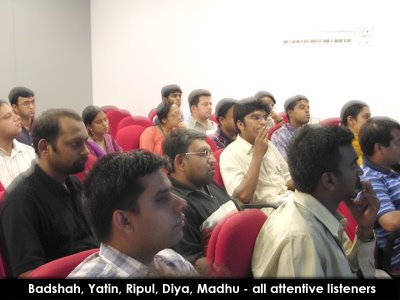
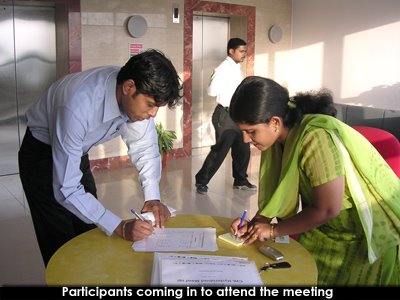
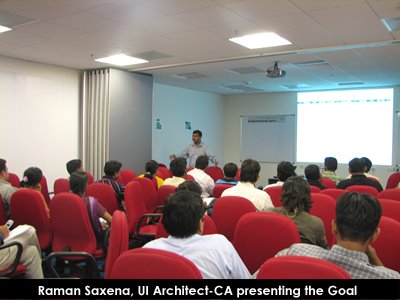
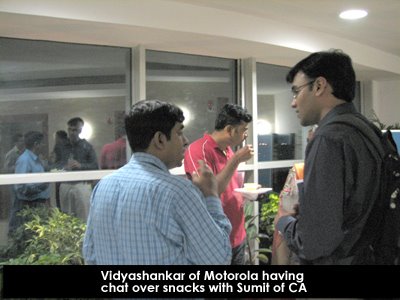
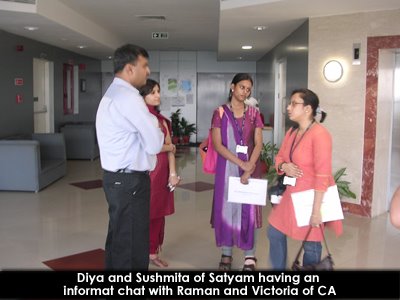
Some collaboration is finally happening among UX professionals in Hyderabad. It is good that we are moving out of our silos and realizing the need for collective efforts to move this niche area to the mainstream of the software industry. On 5th may at the CA office; there was an interesting turnout of UX professionals. The agenda was to discuss the proposal of a CHI chapter in Hyderabad. Raman saxena, UI architect, CA, organized the meet up along with Victoria, also of CA, and Ripul, of kern communications.
It was an informal meetup with Raman presenting the need for having the Hyderabad CHI chapter and the attendees participating and sharing their views. The Infosys UX AVP Sridhar Mari also spoke on how Infosys started its usability practice, and the need for a design school. It is absolutely essential that UX professionals meet on a regular basis so that we can share our experiences, and get to learn from other professionals in this space.
To all HCI aficionados, please take out some time and send feedback on the proposed CHI chapter to victoria.chattopadhyay(at)ca.com. Attached are some meet photos taken by Victoria. " Click on the thumbnails for an enlarged view"


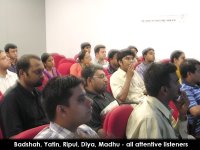


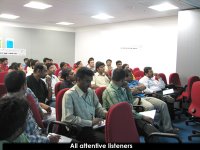


It was an informal meetup with Raman presenting the need for having the Hyderabad CHI chapter and the attendees participating and sharing their views. The Infosys UX AVP Sridhar Mari also spoke on how Infosys started its usability practice, and the need for a design school. It is absolutely essential that UX professionals meet on a regular basis so that we can share our experiences, and get to learn from other professionals in this space.
To all HCI aficionados, please take out some time and send feedback on the proposed CHI chapter to victoria.chattopadhyay(at)ca.com. Attached are some meet photos taken by Victoria. " Click on the thumbnails for an enlarged view"





 User Experience Architect, Information Architect, Usability Professional,Doer, Abstract Expressionist,
May 4, 2006
Information Architecture & Strategic thinking
Strategic thinking and information architecture go hand in hand. Information architecture as a profession is not merely site navigation, structuring, or for that matter search. You are positioning products, services, and information in a way that is aligned with strategy, business goals & customer goals.
You are not only defining the customer experience, you are also translating the business strategy into a virtual reality. Do you think strategically; can you envisage the big picture? If you think you can, then do send me your resume/portfolio at masood_nasser(at)rediffmail.com
Strategic thinking and information architecture go hand in hand. Information architecture as a profession is not merely site navigation, structuring, or for that matter search. You are positioning products, services, and information in a way that is aligned with strategy, business goals & customer goals.
You are not only defining the customer experience, you are also translating the business strategy into a virtual reality. Do you think strategically; can you envisage the big picture? If you think you can, then do send me your resume/portfolio at masood_nasser(at)rediffmail.com
User Experience Architect, Information Architect, Usability Professional,Doer, Abstract Expressionist,
Subscribe to:
Posts (Atom)